A food truck owner I know worked a weekend festival, and a portable generator sparked a fire. It burned through her truck’s wiring and scorched the vendor tent next to hers.
She owed the neighboring vendor’s losses, the festival organizer wanted proof of coverage, and her own truck was out of service for six weeks. Her policy handled all three, mostly because a few months earlier she’d upgraded from a bare-minimum plan.
“I thought insurance was for big companies,” she told me. “Turns out it’s for anyone who can’t afford to lose everything.”
That’s the honest pitch for small business insurance plans. You’re not buying paperwork. You’re deciding whether a single bad day can end the business you’ve spent years building. This guide walks you through what coverage you need, when you need it, and what it costs.
[Internal Link: “Business Insurance Plans for U.S. Businesses”]
What Are Small Business Insurance Plans?
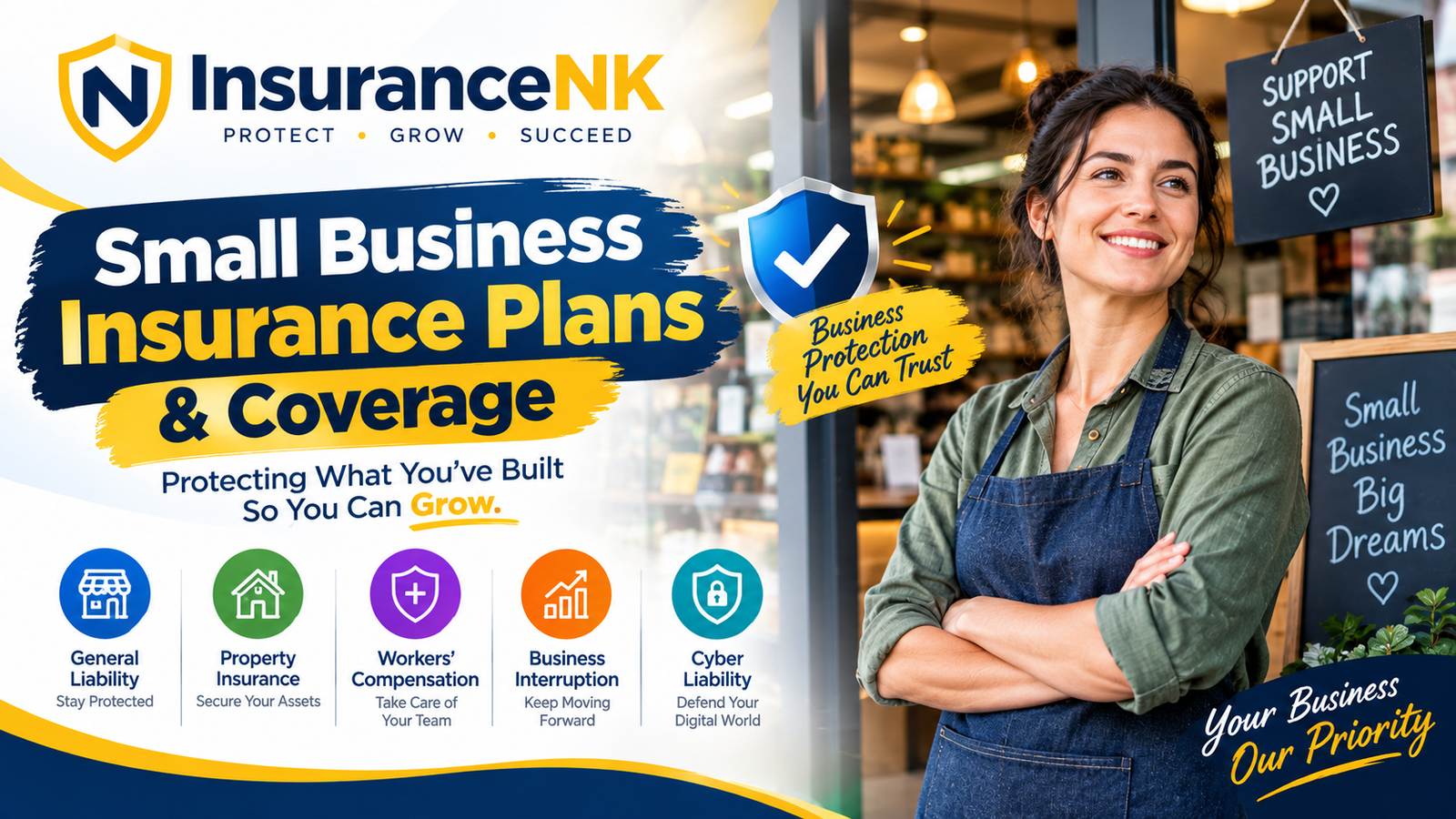
Small business insurance plans are packages of coverage designed to protect smaller companies from lawsuits, property loss, employee injuries, cyber incidents, and income disruption. They’re typically built from a few core policies, priced by your industry, size, and risk.
Think of them as a set of separate shields. Each one blocks a different kind of hit. No single policy covers everything, which is exactly why plans exist.
Plans vs. Individual Policies
An individual policy covers one risk, like general liability or workers’ comp. A plan bundles several. The most common bundle for small firms is the business owner’s policy (BOP), which combines general liability, commercial property, and business income coverage.
Plans usually cost less than buying the same coverages one at a time. They’re also simpler to manage, with one renewal date and one point of contact.
Who Counts as a “Small Business”?
The SBA defines “small” differently by industry, using employee counts or revenue thresholds. In practice, when insurers talk about small business insurance, they usually mean companies with fewer than about 50 to 100 employees and modest revenue. That includes solo freelancers, home-based shops, restaurants, contractors, boutiques, and small offices.
If you’re a solo operator, you count. Size doesn’t decide whether you need coverage. Exposure does.
What’s Typically Excluded
Even good plans have blind spots. Standard small business insurance coverage usually excludes:
- Flood and earthquake damage
- Employee injuries (under general liability)
- Professional mistakes (under general liability)
- Cyber events (unless you add cyber coverage)
- Business use of personal vehicles
Knowing what’s excluded is as important as knowing what’s covered.
[Internal Link: “what your business insurance policy doesn’t cover”]
Why Small Business Insurance Coverage Matters Right Now
Let me start with the personal side, because that’s what keeps owners up at night.
The Personal-Asset Risk
If you operate as a sole proprietor or general partnership, there’s no legal wall between you and the business. A lawsuit can reach your savings, your car, even your home. Forming an LLC or corporation helps, but it isn’t a force field. Courts can pierce that protection when businesses are undercapitalized or owners mix personal and business finances.
Insurance is the layer that pays the claim and covers legal defense costs before your personal assets come into play. Defense costs alone can run into five figures, even when you win.
Contracts, Leases, and Licenses
Here’s what surprises new owners. Insurance is often required by other people before the law ever gets involved.
- Landlords typically require general liability and sometimes property coverage.
- Clients and general contractors often require specific limits and additional insured status.
- Licensing boards in many trades require proof of coverage or a bond.
- Event organizers and vendors’ markets frequently ask for a certificate of insurance.
I’ve seen owners lose opportunities not because of quality, but because they couldn’t send a certificate by end of day.
The 2026 Market Reality
Two trends are worth knowing. First, commercial property premiums have climbed in recent years, especially in regions prone to storms and wildfires. Second, insurers are asking more questions about cybersecurity, including whether you use multi-factor authentication and maintain backups, before they’ll quote cyber coverage.
The takeaway: shopping early and being organized pays off. Businesses that can show good practices tend to get better terms.
[Internal Link: “cybersecurity basics insurers look for”]
The Stage-Based Coverage Ladder: How Small Business Insurance Plans Should Grow With You
Most guides list every policy type and leave you to figure it out. I prefer a different approach. I call it the Stage-Based Coverage Ladder, because your insurance needs change as your business does. You don’t need everything on day one, and you shouldn’t stay at the bottom rung forever.
Stage 1: Launch (Solo or Just Getting Started)
You’re new, probably working alone or with a few contractors, and cash is tight.
Your foundation:
- General liability for third-party injury and property damage
- Professional liability if you provide advice or services clients rely on
- Basic property coverage for equipment, or a home-based business endorsement if you work from home
Why it matters here: Your first client contract or lease will likely ask for proof of general liability. Get this in place before you need it, not the day before.
My take: If you can only afford one thing at launch, make it general liability. If you sell expertise, professional liability jumps to the same priority. A designer, consultant, or bookkeeper can face a claim without anyone ever getting physically hurt.
Stage 2: First Hire
Someone else is now on your payroll. Everything changes.
Add:
- Workers’ compensation. In nearly every state, having employees triggers this requirement. Rules vary by state and headcount, so confirm yours.
- Consider a BOP if you have a physical location, inventory, or equipment worth protecting.
- Employment practices liability (EPLI) if you’re hiring, firing, or managing more people, since wrongful-termination and discrimination claims can hit small companies hard.
Where people slip: Treating a first employee as a contractor to avoid workers’ comp. Misclassification can lead to back premiums, penalties, and legal trouble. If you’re unsure, ask a licensed professional before you decide.
Stage 3: Contracts and Growth
You’re landing bigger clients, buying more equipment, and maybe driving more.
Add or upgrade:
- Higher liability limits. Larger contracts often require $1 million per occurrence or more.
- Commercial auto for any vehicles used in the business. Personal auto policies generally won’t cover business use.
- Cyber liability, especially if you store customer data or take online payments.
- Additional insured endorsements and certificates on demand.
- Umbrella coverage for extra liability limits above your base policies.
The rule at this stage: Your insurance should never be the reason you lose a contract. Ask what limits your largest prospects require, then work backward.
Stage 4: Scale
Multiple locations, dozens of employees, or operations across states.
Consider:
- Multi-state workers’ comp and compliance
- Directors and officers (D&O) coverage if you have a board or outside investors
- Business interruption with extended limits
- Crime and fidelity coverage for employee theft
- A risk management review with a broker who understands your industry
By this point, working with a broker rather than buying online-only often pays for itself.
A Quick Note on Industry
The ladder holds across industries, but the rungs look different:
- Restaurants and retail lean heavily on property, liquor liability where applicable, and business income coverage.
- Contractors and trades need strong general liability, workers’ comp, tools and equipment coverage, and often a license bond.
- Consultants and creatives prioritize professional liability and cyber.
- Home-based and online sellers need product liability and coverage for inventory and shipping risk.
What Drives Small Business Insurance Cost
Everyone asks “how much?” and nobody likes “it depends.” So here’s what it depends on, which is more useful than a made-up average.
Industry and Class Code
Insurers classify your business by the work you do, and each class carries a risk rating. A graphic designer and a roofer face very different odds of a claim, so they pay very different rates. Being classified correctly matters. A wrong class code can inflate your premium or, worse, cause a coverage dispute later.
Payroll, Revenue, and Location
Premiums scale with exposure. Higher payroll increases workers’ comp costs. Higher revenue raises general liability costs. Location matters too, since property rates reflect local weather and crime risk, and some states have higher liability and workers’ comp costs than others.
Claims History and Risk Controls
A clean loss history helps. So do safety programs, written procedures, security systems, background checks, and cyber hygiene. In my experience, owners who document their safety practices get better conversations with underwriters. It won’t work miracles, but it moves the needle.
Coverage Limits and Deductibles
Higher limits cost more. Higher deductibles cost less, but only choose a deductible you could pay from cash tomorrow. A $5,000 deductible you can’t afford isn’t a savings. It’s a delayed problem.
A practical note: For a low-risk small business, general liability alone can sometimes be modest, while workers’ comp for a trade business or a package for a restaurant will cost considerably more. Cost varies enough that only real quotes based on your numbers are worth trusting.
Where to Buy: Direct, Agent, or Broker?
- Online direct: Fast and convenient for simple, low-risk needs.
- Captive agents: Represent one insurer. Good if their product fits.
- Independent agents and brokers: Compare multiple carriers and advise on complex needs.
For simple Stage 1 needs, online can work well. As your risks grow, I’d rather have a human who knows the market in my corner.
[Internal Link: “how to choose between an insurance agent and a broker”]
Common Mistakes People Make (and How to Avoid Them)
I’ve made one or two of these myself, and I keep seeing the rest.
1. Waiting until you need it. You can’t buy coverage after the accident. Many policies also have waiting periods or require disclosure of known incidents.
2. Choosing coverage by price alone. A cheap policy with heavy exclusions can cost you far more when a claim arrives. Compare coverage, not just premiums.
3. Assuming home insurance covers your home business. Homeowner’s policies often cap business property at a low limit and exclude business liability. This gap is one of the most common I see.
4. Understating payroll or revenue. Auditors check. Underreporting can trigger surprise bills and coverage disputes.
5. Skipping workers’ comp on a “small” team. Even one employee can trigger requirements, and one injury can be devastating without it.
6. Not reading the exclusions. Honestly, most people get this wrong. They skim the summary and never check what’s carved out.
7. Never reviewing the policy. Hiring, new services, new equipment, and new locations all change your needs. Review at least annually.
Expert Tips & Advanced Strategies
Here’s the advice I’d give a friend who runs a business.
1. Ask for a certificate template early. If you’ll need certificates often, ask your agent how fast they issue them. Speed can decide a deal.
2. Understand claims-made vs. occurrence. Occurrence policies cover incidents during the policy period. Claims-made policies cover claims filed during the period, so switching carriers may require tail coverage. Know which you have.
3. Bundle with intention. A BOP typically saves money for lower-risk businesses, but don’t let a bundle talk you out of specialized coverage you actually need.
4. Pair cyber coverage with actual security. Multi-factor authentication, regular backups, and staff training make claims less likely and coverage easier to get.
5. Watch your business income waiting period. Many policies wait a period, often around 72 hours, before income replacement starts. Plan your cash cushion around it.
6. Keep your paperwork clean. Separate business and personal finances, keep contracts organized, and document safety practices. It helps with both claims and underwriting.
7. Do a pre-renewal check-in every year. Schedule it 60 to 90 days before renewal so you have time to shop around, not just accept whatever arrives.
[Internal Link: “annual insurance review checklist for small business owners”]
(The comparison table appears in Section 4 below.)
Real Results & Case Studies
[Editor note: Replace this with a real, documented InsuranceNK client story before publishing. The scenario below is illustrative and shows the level of specificity that tends to build trust and rank well.]
The situation: A four-person residential remodeling company had a basic general liability policy and no workers’ comp, because the owner had classified the crew as independent contractors. They’d just landed their biggest project, a $180,000 kitchen and addition.
The problem: The homeowner’s contract required proof of workers’ comp and $1 million in general liability. The crew classification also didn’t hold up under review, which meant the company was likely misclassifying employees.
The fix: They restructured, put the crew on payroll, added workers’ comp, upgraded to a BOP with higher limits, and added tools and equipment coverage. Their annual premium rose meaningfully, but it was a small fraction of the project’s value.
The outcome: They kept the contract. Four months in, a crew member fell from a ladder and needed medical care. Workers’ comp handled the medical costs and lost wages. Without it, the owner told me, the claim would have exceeded the project’s profit.
The point isn’t the numbers. It’s that the gap you’re most tempted to skip is often the one that shows up first.
Who Should (and Shouldn’t) Use Each Kind of Plan
Not every plan is right for every owner. Here’s my honest take.
Best Fits
- A BOP suits small retailers, restaurants, salons, offices, and shops with a physical space and equipment.
- Standalone professional liability plus cyber suits consultants, agencies, designers, and other service businesses.
- Workers’ comp plus higher-limit general liability suits contractors and trades.
- A home-based business policy suits solo operators working from a home office with limited equipment.
Poor Fits
- A basic BOP isn’t enough for high-risk operations like heavy construction, manufacturing, or transport, which need industry-specific coverage.
- Rock-bottom coverage is a poor fit if your contracts require higher limits. You’d pay for a policy that still doesn’t meet requirements.
- Buying everything at once is unnecessary for a brand-new solo business with minimal exposure. Start with your Stage 1 essentials and climb the ladder.
If you’re on the fence, a short conversation with a licensed agent beats guessing.
Conclusion
Here’s what I’d want you to take away. Small business insurance plans aren’t a tax on being in business. They’re what lets you take normal business risks without betting the whole company.
Start where you are on the ladder. Launch with general liability and, if you sell expertise, professional liability. Add workers’ comp with your first hire. Build up limits, cyber, and auto as contracts and operations grow. Read your exclusions, keep your records clean, and review your coverage every year.
The food truck owner kept her business because she’d climbed one rung before she needed to. You can do the same, and it’s a lot cheaper to climb before the fire than after.
Want to see what’s right for your stage? Request a free, no-obligation quote from InsuranceNK and compare small business insurance plans built around how you actually operate. [CTA button/link: Get Your Free Quote]
4. Comparison Table: Small Business Insurance Plan Options
| Feature | Basic Starter (GL only) | Business Owner’s Policy (BOP) | Professional + Cyber Package | Trades / Contractor Package | Growth Package (BOP + umbrella + add-ons) |
|---|---|---|---|---|---|
| What it covers | Third-party injury, property damage, advertising injury | GL + commercial property + business income | Client-loss claims from errors, plus data breach response | GL, workers’ comp, tools/equipment, often license bond | BOP plus higher limits, EPLI, cyber, and commercial auto |
| Best for | Solo operators, low-risk start-ups | Shops, restaurants, offices, small retail | Consultants, agencies, designers, IT services | Contractors, remodelers, electricians, landscapers | Growing firms with larger contracts and more staff |
| Business stage | Stage 1 | Stages 1–3 | Stages 1–4 | Stages 2–3 | Stages 3–4 |
| Common gaps | No property, income, or employee coverage | No workers’ comp, auto, or professional coverage | No bodily injury or property damage | Limited cyber or professional coverage | Needs regular limit reviews as you scale |
| Often required by | Landlords, clients, event organizers | Lenders and landlords | Client contracts | Licensing boards, general contractors | Large clients, investors, lenders |
| Cost / complexity | Lowest cost, easiest to buy | Moderate, often good value | Moderate, varies by revenue and data volume | Higher, driven by payroll and job risk | Highest, best handled with a broker |
Costs vary widely by state, industry, payroll, revenue, and claims history. Always base decisions on quotes for your actual business.
5. FAQ Section
1. What insurance does a small business need to start?
Most new small businesses should start with general liability insurance, since landlords and clients often ask for it. If you provide advice or services, add professional liability. If you work from home, confirm whether your homeowner’s policy excludes business activity, because it often does. Once you hire an employee, workers’ compensation usually becomes required. In my experience, starting with these basics and adding as you grow keeps costs manageable without leaving major gaps.
2. How much does small business insurance cost per month?
It varies widely with your industry, revenue, payroll, location, limits, and claims history. A low-risk solo business might pay a modest amount for general liability alone, while a contractor or restaurant may pay far more for a full package. Bundling through a business owner’s policy often lowers the combined cost. Honestly, any single “average” number can mislead you, so get quotes based on your real details.
3. Do I need business insurance if I’m a sole proprietor?
Yes, and arguably more so. As a sole proprietor, you have no legal separation between personal and business assets, so a lawsuit can reach your savings or home. Even if the law doesn’t require coverage, clients and landlords often will. General liability is the usual starting point, and professional liability matters if you give advice or provide services. I’d treat it as a baseline, not a luxury.
4. What’s the difference between general liability and professional liability?
General liability covers third-party bodily injury, property damage, and advertising injury, such as a customer slipping in your shop. Professional liability, also called errors and omissions, covers claims that your advice or services caused a client financial loss, such as a missed deadline or a costly mistake. If you sell expertise, general liability alone won’t cover those claims. Many service businesses need both.
5. When do I need workers’ compensation for my small business?
In most states, you need workers’ comp once you have employees, though thresholds and rules vary by state and business type. Texas is a notable exception, allowing most private employers to opt out. Independent contractors may be treated differently, but misclassifying employees as contractors can create serious legal and financial risk. If you’re unsure, check your state’s requirements or ask a licensed agent before your first hire.
6. Is a business owner’s policy (BOP) worth it for a small business?
For many small businesses with a physical location, equipment, or inventory, yes. A BOP bundles general liability, commercial property, and business income coverage, usually for less than buying them separately. It’s a poor fit for high-risk industries or businesses needing specialized coverage. In my opinion, a BOP is the best starting point for a small shop or office, then you add professional liability or cyber as needed.
7. Does homeowner’s insurance cover my home-based business?
Usually not much. Homeowner’s policies often cap business property coverage at a low amount and typically exclude business liability, such as a client injured at your home office. If you run a business from home, a home-based business policy or a small BOP can close the gap affordably. I’ve seen this gap surprise plenty of owners, so it’s worth checking your policy language.
8. Do small businesses really need cyber insurance?
If you store customer data, accept online payments, or rely on digital systems, it’s worth serious consideration. Small businesses are frequent targets because they often have weaker defenses than large companies. Cyber coverage can help pay for forensic investigation, customer notification, legal costs, and recovery after an incident. Insurers increasingly ask about security practices like multi-factor authentication, so basic cyber hygiene helps with both coverage and cost.
9. Can I get small business insurance online, or should I use an agent?
Both work. Online purchasing is fast and convenient for simple, low-risk needs. An independent agent or broker becomes more valuable as your risks grow, since they compare carriers, explain exclusions, and help at claim time. My rule of thumb: buy online if your needs are straightforward, and bring in a professional once you have employees, larger contracts, or specialized exposure.
10. How often should I review my small business insurance?
At least once a year, ideally 60 to 90 days before renewal so you have time to compare options. Also review after any major change, like hiring, adding a location, buying expensive equipment, launching a new service, or signing a larger contract. Your risks evolve with your business, and a policy that fit last year may leave gaps today.