


Introduction
Artificial intelligence is changing how people discover brands online. Instead of clicking through pages of search results, many users now ask AI assistants direct questions such as “What is the best CRM for startups?” “Which project management software is best for remote teams?”, or “What are the top cybersecurity tools for small businesses?” AI platforms like Perplexity, ChatGPT, Google AI Overviews, and Microsoft Copilot generate complete answers by combining information from multiple trusted sources rather than simply displaying a list of websites.
This shift has created a new challenge for businesses. Ranking on Google’s first page is no longer the only measure of online visibility. Companies also want to know whether AI assistants mention their brand, cite their website, or recommend their products when users ask relevant questions.
As AI-powered discovery becomes more common, monitoring brand visibility inside AI-generated answers is becoming an important addition to traditional SEO. According to Adobe’s 2026 AI and Digital Trends Report, one in four customers already use AI-powered platforms as their primary source for finding information and recommendations, or for making purchase decisions, surpassing brand websites and online reviews for many users.
This growing behavior has led to the rise of AI brand-mention monitoring, a category of tools designed to track how brands appear in AI-generated responses across platforms like Perplexity, ChatGPT, Google AI Overviews, and Gemini.
But is investing in Perplexity AI brand-mention monitoring actually worth it in 2026?
The answer depends on your business goals, your content strategy, and the extent to which AI-driven discovery contributes to your marketing efforts. In this guide, we’ll explain what these tools do, who benefits most from them, and why they are becoming an important part of modern SEO and Answer Engine Optimization (AEO).

Adobe – 2026 AI and Digital Trends Report
What Is Perplexity AI Brand Mention Monitoring?
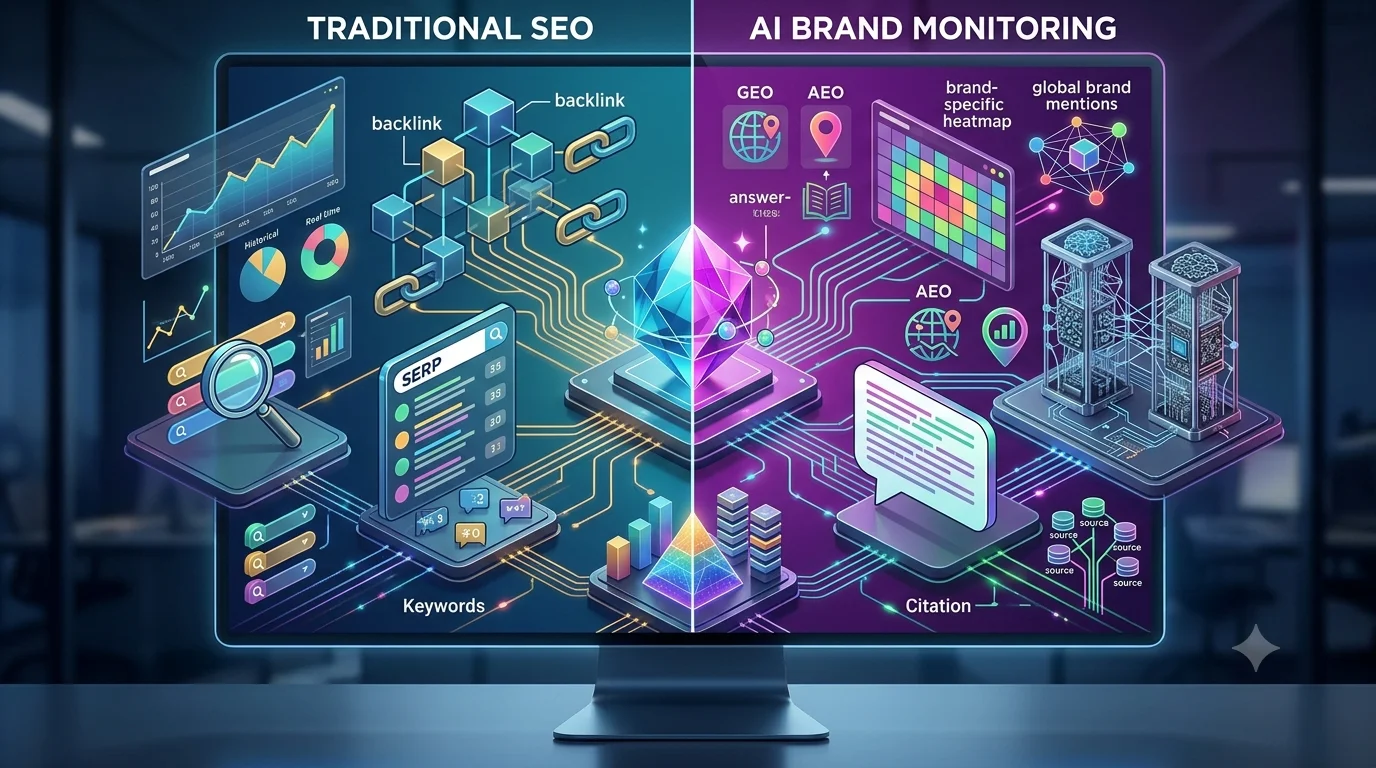
Perplexity AI brand mention monitoring is the process of tracking how often your business, products, or website appears in Perplexity AI’s generated answers. Unlike traditional SEO tools that focus on keyword rankings or backlinks, these monitoring platforms analyze AI-generated responses to understand whether your brand is being referenced when users ask industry-related questions.
Depending on the platform you use, monitoring typically includes:
- Brand mentions with or without clickable links.
- Citations pointing to specific pages on your website
- Frequently cited competitors
- AI prompt coverage across different topics
- Changes in visibility over Time
- Share of voice compared with competing brands
Instead of asking only “Where does my website rank?”, marketers are beginning to ask:
- Does Perplexity recommend my company?
- Which pages receive AI citations?
- Which competitors appear more often?
- Which topics generate the highest AI visibility?
- Where are the biggest content gaps?
These insights help businesses understand how AI systems interpret their authority within a particular niche.
Why Traditional SEO Tools Are No Longer Enough
For years, SEO success was measured using rankings, impressions, clicks, backlinks, and organic traffic. Those metrics remain important, but they no longer tell the complete story.
Today, many users receive answers directly from AI systems without visiting multiple websites. If your brand is consistently cited inside AI-generated responses, it may gain exposure even when users never perform a traditional Google search.
Traditional SEO platforms like Google Search Console remain essential because they show:
- Search impressions
- Click-through rates
- Average rankings
- Indexed pages
- Search queries
However, they cannot answer questions like:
- Did Perplexity recommend my brand?
- Did ChatGPT cite my research?
- Which AI-generated answers include my competitors instead?
This is where AI visibility monitoring complements—not replaces—traditional SEO.
The Shift Toward AI-Powered Discovery
Artificial intelligence is rapidly becoming part of everyday online experiences. Consumers increasingly rely on AI to compare products, summarize information, and receive personalized recommendations.
Adobe’s 2026 AI and Digital Trends Report found that:
- 49% of customers would use AI for personalized product recommendations.
- 44% would use AI for instant customer support.
- One in four customers already rely on AI-powered platforms as their primary source for information and recommendations.
For marketers, this represents a significant change in customer behavior.
Rather than competing only for traditional search rankings, businesses increasingly need to understand how AI assistants choose which brands to mention, which sources to trust, and which pages deserve citations.
Why AI Brand Mentions Matter
When an AI assistant recommends your business, users often perceive that recommendation as a sign of credibility. Although AI-generated answers are not perfect and should not be treated as endorsements, appearing consistently in relevant responses can improve brand visibility during the research phase of the customer journey.
Potential benefits include:
- Increased brand awareness
- Greater exposure during AI-assisted research
- Better understanding of competitor visibility
- Identification of content gaps
- Insights for improving topical authority
However, it’s important to remember that AI citations are not a direct Google ranking factor. They should be viewed as an additional visibility signal rather than a replacement for strong SEO fundamentals such as high-quality content, technical optimization, authoritative backlinks, and a positive user experience.
Who Should Use Perplexity AI Brand Mention Monitoring?
Not every website needs dedicated AI monitoring software. The value depends on your industry, competition, and marketing goals.
These tools are generally most useful for:
SEO Agencies
Agencies managing multiple clients can use AI visibility reports alongside traditional SEO metrics to demonstrate how clients appear across AI-powered search experiences.
SaaS Companies
Software buyers increasingly research products through AI assistants before requesting demos or starting free trials. Monitoring AI citations can reveal whether your product appears during those early research stages.
Enterprise Brands
Large organizations often compete across hundreds of topics. AI monitoring helps identify where competitors are being cited more frequently and where additional content investment may be needed.
Publishers and Content Websites
Publishers producing original research, guides, case studies, or educational content can evaluate which articles AI systems reference most often and identify opportunities to strengthen topical authority.
Digital PR Teams
Brands investing in media coverage and authoritative mentions can monitor whether those efforts improve AI-generated citations over Time.
Who May Not Need It Yet?
Smaller websites with limited content or newly launched businesses may not see immediate value from investing in AI visibility platforms.
According to Adobe’s research, many organizations are still developing the foundations needed for AI adoption. Only 44% say their data quality is currently adequate for AI initiatives, highlighting that many businesses should first strengthen their content, data, and digital infrastructure before investing heavily in advanced AI monitoring tools.
For these businesses, focusing on:
- publishing original content,
- improving technical SEO,
- building topical authority,
- earning high-quality backlinks,
- and creating trustworthy author profiles
will usually provide a stronger return on investment before adopting specialized AI visibility software.
Key Features That Make AI Brand Mention Monitoring Valuable
Not all AI visibility monitoring platforms offer the same capabilities. Some focus solely on tracking mentions within Perplexity AI, while others monitor multiple AI-powered search engines, including ChatGPT, Google AI Overviews, Gemini, and Microsoft Copilot.
If you’re evaluating a monitoring platform in 2026, here are the features that provide the most practical value.
1. Brand Mention Tracking
The core function is to identify when your company, product, or website appears in AI-generated answers.
Instead of manually testing hundreds of prompts every week, monitoring tools automate the process and notify you when your visibility changes.
For example, they can answer questions such as:
- How often does Perplexity recommend my brand?
- Which prompts mention my products?
- Which industries generate the most citations?
This saves significant Time while providing a broader view of AI-driven brand exposure.
2. Citation Monitoring
Mentions alone don’t tell the full story.
Many AI systems include citations or references to the webpages they used when generating an answer.
Citation monitoring helps you identify:
- Which pages receive citations
- Which content formats perform best
- Which competitors are referenced more frequently
- Whether your newest content is being cited
This information can guide future content updates and editorial planning.
3. Prompt Coverage Analysis
Different prompts often produce very different AI answers.
A monitoring platform typically tests hundreds—or even thousands—of carefully selected prompts to measure visibility across an entire topic rather than relying on a handful of manual searches.
Examples include:
- Best CRM software
- Best CRM for nonprofits
- CRM for manufacturing
- CRM for healthcare
- Affordable CRM for startups
This wider coverage provides a more realistic picture of AI visibility.
4. Competitor Share of Voice
Understanding your own visibility is only half the equation.
Most advanced tools compare your brand against competitors to answer questions such as:
- Which competitors appear most often?
- Which topics do they dominate?
- Which prompts never mention your business?
- Where are the biggest content gaps?
These insights help prioritize content creation and identify opportunities to strengthen topical authority.
5. Visibility Trends Over Time
AI-generated answers change frequently as models evolve and new sources become available.
Historical reporting helps marketers understand:
- Whether visibility is improving
- Which updates increased citations
- Which content lost visibility
- Seasonal changes in AI recommendations
Rather than relying on isolated snapshots, trend reports reveal long-term patterns.
The Business Benefits of AI Brand Monitoring
Monitoring AI visibility is most valuable when it informs broader SEO and content decisions—not when it’s treated as a standalone ranking strategy.
Here are the main benefits.
Better Content Prioritization
If AI consistently cites one article but ignores another on the same topic, you gain insight into which content is perceived as more authoritative.
This helps prioritize updates based on real-world AI behavior instead of guesswork.
Stronger Competitive Intelligence
Traditional rank tracking shows where competitors rank in search results.
AI monitoring adds another layer by revealing:
- Which brands AI assistants recommend
- Which websites AI trusts
- Which competitors dominate high-value prompts
These insights can influence editorial calendars, digital PR campaigns, and content strategy.
Improved Answer Engine Optimization (AEO)
As AI assistants become a more common way for people to find information, marketers are paying closer attention to Answer Engine Optimization (AEO) and Generative Engine Optimization (GEO).
Rather than optimizing only for traditional search rankings, AEO focuses on creating content that AI systems can easily understand, trust, and cite when answering user questions.
Smarter Reporting
For agencies and in-house marketing teams, AI visibility reports can complement existing SEO dashboards.
Instead of reporting only:
- rankings,
- traffic,
- impressions,
- backlinks,
teams can also measure:
- AI citations,
- AI brand mentions,
- share of AI voice,
- prompt coverage,
- citation growth over Time
AI Monitoring Is Growing—But So Are the Challenges
While AI visibility monitoring is becoming more important, organizations still face significant implementation challenges.
Adobe’s 2026 AI and Digital Trends Report found that although organizations are seeing measurable gains from generative AI, many still struggle with the foundations required for long-term success.
Key findings include:
- 76% reported an increase in content volume from generative AI.
- 69% saw improved employee productivity.
- 65% reported marketing-related revenue growth.
However, the report also highlights several challenges:
- 52% of organizations struggle to demonstrate measurable returns on AI investments.
- Only 44% have implemented a measurement framework for generative AI.
- Only 31% have a framework for agentic AI.
These findings suggest that simply adopting AI tools isn’t enough. Businesses also need clear measurement strategies, high-quality data, and governance processes to evaluate long-term success.
Top Alternatives to Perplexity AI Brand Mention Monitoring
Perplexity monitoring is useful, but most businesses now track visibility across multiple AI platforms rather than relying on a single engine.
Here are some of the most recognized tools in this growing category.
1. ZipTie
ZipTie focuses on monitoring AI visibility across multiple AI search experiences.
Depending on the plan and product updates, it may include monitoring for:
- Google AI Overviews
- ChatGPT
- Perplexity
The platform emphasizes actionable recommendations, competitive benchmarking, and visibility tracking rather than simple reporting.
Before choosing any platform, review its latest documentation to confirm supported features, pricing, and AI engine coverage, as capabilities evolve frequently.
2. Ahrefs Brand Radar
Ahrefs has expanded beyond traditional SEO by introducing AI-focused visibility reporting.
It combines search performance data with AI brand monitoring to help marketers understand how often their brands appear across emerging AI-powered search experiences.
3. Semrush AI Toolkit
Semrush continues expanding its AI capabilities with tools that help marketers evaluate visibility, optimize content, and monitor AI-driven search performance alongside traditional SEO metrics.
4. Profound
Profound primarily targets enterprise organizations that require large-scale prompt testing, detailed reporting, and competitive AI visibility analysis across multiple industries.
5. Peec AI
Peec AI focuses on monitoring brand visibility inside AI-generated answers while helping organizations understand which prompts generate citations and where competitors dominate.
6. Scrunch
Scrunch offers multi-LLM monitoring and optimization capabilities for organizations seeking to measure AI visibility across multiple conversational search platforms.
Which Tool Is Best?
There is no universal winner.
The best choice depends on:
- business size,
- reporting requirements,
- supported AI platforms,
- pricing,
- workflow integration,
- historical reporting,
- competitive analysis,
- optimization features.
Many organizations combine an AI visibility platform with traditional SEO tools such as Google Search Console and analytics software rather than replacing existing workflows.
How to Increase Your Brand’s AI Mentions
Monitoring only creates value if you act on the insights.
Here are practical strategies that align with current SEO and content best practices.

Publish Original Research
AI systems frequently reference content containing unique statistics, surveys, industry reports, or proprietary research.
Instead of rewriting existing information, create resources that contribute new knowledge to your industry.
Build Topical Authority
Publishing one article is rarely enough.
Develop comprehensive topic clusters covering related questions, tutorials, comparisons, case studies, and industry trends.
This helps establish expertise across an entire subject area.
Strengthen E-E-A-T Signals
Clearly identify authors, include professional credentials where appropriate, maintain accurate publication dates, and cite authoritative sources throughout your content.
Strong Experience, Expertise, Authoritativeness, and Trustworthiness (E-E-A-T) signals improve content credibility for both readers and search engines.
Keep Content Updated
AI systems often prioritize current and accurate information.
Review articles regularly to:
- update statistics,
- refresh screenshots,
- replace outdated references,
- add recent developments,
- correct obsolete recommendations.
Improve Internal Linking
Logical internal links help users discover related content while reinforcing topical relationships across your website.
Connecting supporting articles to comprehensive pillar pages also makes it easier to maintain content clusters.
Pros and Cons of Perplexity AI Brand Mention Monitoring
Like any SEO or analytics platform, AI brand monitoring has strengths and limitations. Understanding both helps you decide whether it’s the right investment for your business.
Pros
1. Measures AI Visibility Beyond Traditional SEO
Traditional SEO tools focus on rankings, impressions, and clicks. AI monitoring platforms provide an additional layer of insight by showing how often your brand appears in AI-generated answers across platforms like Perplexity, ChatGPT, and Google AI Overviews.
2. Improves Competitive Intelligence
These tools help marketers understand:
- Which competitors receive more AI citations
- Which topics competitors dominate
- Which content types AI systems reference most often
- Where new content opportunities exist
This makes content planning more strategic rather than relying on assumptions.
3. Supports AEO and GEO Strategies
Answer Engine Optimization (AEO) and Generative Engine Optimization (GEO) have become increasingly important as AI-powered search continues to evolve.
Monitoring tools provide data that can guide improvements in content quality, topical authority, and citation potential.
4. Helps Prioritize Content Updates
Instead of updating every article equally, marketers can focus on pages with the greatest potential to gain AI citations, based on monitoring insights.
5. Saves Time
Manually testing hundreds of prompts across multiple AI platforms every week is time-consuming.
Monitoring platforms automate much of this work by collecting visibility data at scale.
Cons
1. AI Answers Change Frequently
Large language models are updated regularly.
A page cited today may not appear tomorrow because:
- AI models evolve
- Source selection changes
- New competitors publish better content.
- Prompt wording changes
AI visibility should therefore be viewed as directional rather than permanent.
2. Not Every Prompt Can Be Tracked
No monitoring platform can test every possible user question.
Most tools rely on selected prompt libraries, meaning visibility reports represent a sample rather than the complete picture.
3. Doesn’t Replace Traditional SEO
Ranking well in AI-generated answers still depends on many traditional SEO factors, including:
- Technical SEO
- Helpful content
- Site authority
- Backlinks
- User experience
- Content freshness
AI monitoring complements SEO—it does not replace it.
4. May Be Less Valuable for Small Websites
If your site has only a handful of articles or limited topical authority, investing in AI monitoring software may provide limited immediate value.
For newer websites, resources are often better spent on creating original, high-quality content before adopting specialized AI visibility tools.
Best Practices for Increasing AI Citations
If your goal is to improve how often AI systems reference your content, focus on creating resources that demonstrate genuine expertise and provide value to readers.
Publish Original Research
Unique surveys, industry studies, benchmarks, and proprietary data are more likely to be cited than rewritten summaries of existing information.
Build Comprehensive Topic Clusters
Cover your niche thoroughly by publishing supporting guides, comparisons, tutorials, FAQs, and case studies around a central topic.
Cite Authoritative Sources
Reference trusted organizations whenever you include statistics or industry trends.
Examples include:
- Adobe
- Google Search Central
- HubSpot
- Gartner
- Microsoft
- Oxford Economics
Well-sourced content helps improve credibility.
Demonstrate Firsthand Experience
Where appropriate, include:
- screenshots,
- product testing,
- real examples,
- case studies,
- workflows,
- original observations.
Experience is a key part of Google’s E-E-A-T principles.
Keep Information Current
Review important articles regularly to update:
- statistics,
- screenshots,
- product features,
- pricing,
- references,
- examples.
Fresh content is more useful for readers and more likely to remain accurate.
HubSpot – State of Marketing Report

Frequently Asked Questions
No. Monitoring itself does not improve rankings. Instead, it provides insights into how your brand appears in AI-generated answers, helping you identify opportunities to strengthen your content strategy.
It depends on your goals.
Businesses with well-established content libraries and active SEO campaigns are generally more likely to benefit than newly launched websites with limited content.
No.
Google Search Console remains essential for measuring search impressions, clicks, indexing, and technical search performance.
AI monitoring should be viewed as a complementary reporting tool rather than a replacement.
Many organizations monitor visibility across multiple AI-powered search experiences, including:
Perplexity
ChatGPT
Google AI Overviews
Gemini
Microsoft Copilot
The ideal combination depends on your audience and marketing objectives.
Weekly or monthly reporting is generally sufficient for most businesses.
However, organizations that publish large volumes of content or run major marketing campaigns may choose to monitor AI visibility more frequently.
Final Verdict
Perplexity AI brand mention monitoring is worth considering in 2026, particularly for organizations that already invest in SEO, digital PR, and content marketing.
As AI-powered search continues to influence how people discover products and services, understanding how your brand appears in AI-generated answers can provide useful competitive insights. However, these tools should not be viewed as standalone ranking solutions. They are most effective when combined with strong SEO fundamentals, original research, technical optimization, and a consistent focus on publishing trustworthy, high-quality content.
Industry research also suggests that many organizations are still developing the infrastructure needed to scale AI effectively. Adobe’s 2026 AI and Digital Trends Report found that while many businesses report improvements from generative AI, only 44% have implemented a measurement framework for generative AI, and just 31% have one for agentic AI, highlighting the importance of building reliable measurement processes alongside AI adoption.
Ultimately, success in AI-powered search is unlikely to come from monitoring alone. Businesses that combine original research, topical authority, clear author expertise, and ongoing content improvements are better positioned to earn visibility across both traditional search engines and AI-generated answers.
Ziptie AI Search Performance Tool Review (2026): Is It the Best AI Search Analytics Platform?
Claude Code vs OpenCode: Which AI Coding Tool Wins in 2026?
Hammer AI Review 2026: Best Free AI Character Chat & Roleplay Platform?
Now exploring our New Free Tools: “IMAGE TO WEBG” “Turn images into one PDF”